
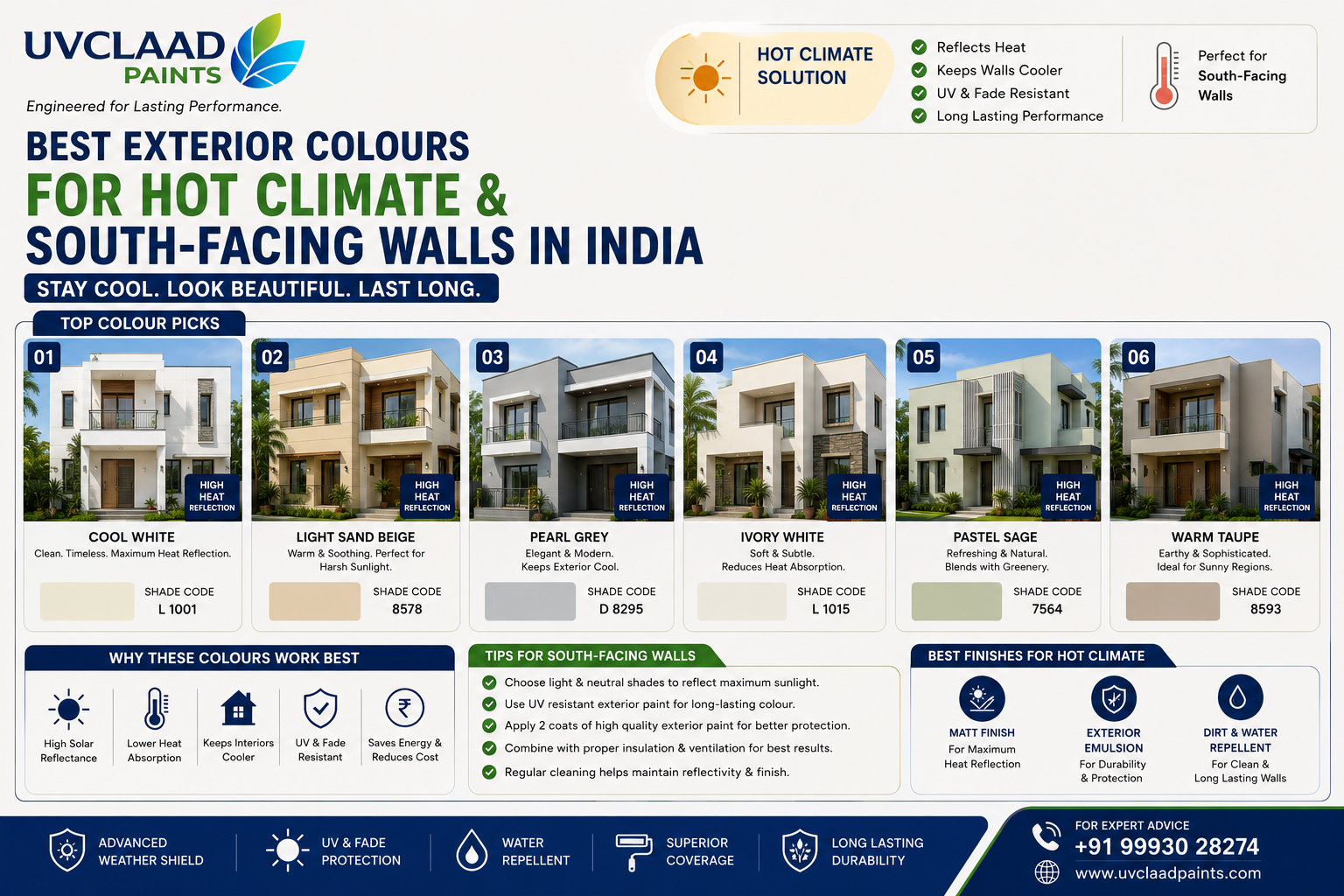
Put your palm on a dark wall and a light wall on the same building at four in the afternoon in May. The difference is not subtle. One is warm, the other is genuinely difficult to keep your hand on.
That difference is free to obtain and it lasts as long as the paint does.
How Much Difference Colour Actually Makes
Under peak Indian summer conditions, measured surface temperatures on identically constructed walls typically show:
| Wall colour | Approx. reflectance | Typical surface temp, May afternoon |
|---|---|---|
| Pure white | 85-90% | 42-46°C |
| Ivory / warm white | 78-85% | 44-48°C |
| Light beige | 65-75% | 46-50°C |
| Light grey | 55-65% | 48-52°C |
| Mid brown / terracotta | 30-40% | 54-58°C |
| Charcoal grey | 15-20% | 58-64°C |
| Near black | 5-10% | 62-70°C |
Ambient air temperature in these conditions is around 42 to 44 degrees. A white wall sits close to air temperature. A charcoal wall runs roughly 20 degrees above it.
That excess heat conducts through the wall and radiates into the room behind it, typically for several hours after sunset.
Light Reflectance and Solar Reflectance Explained
Two related but different measurements, and the distinction matters.
Light reflectance value (LRV) measures reflection of visible light only, from 0 to 100. It is what shade cards sometimes publish.
Solar reflectance measures reflection across the full solar spectrum, including infrared. Since roughly half the sun’s energy arrives as infrared rather than visible light, this is the figure that actually governs heat gain.
Usually the two track each other closely, so LRV is a reasonable proxy. The exception is specialist heat-reflective coatings, which are formulated to reflect infrared strongly while remaining visually darker than their thermal performance would suggest. This is how you get a mid-tone colour that performs closer to a light one.
Measured Temperature Differences by Shade
Beyond comfort, the practical consequences of a hot wall are worth stating.
Higher cooling load, since heat entering through walls is a substantial share of residential cooling demand in Indian summers. Greater thermal movement in the wall, which contributes to cracking over time. Faster paint degradation, because the binder ages more quickly at elevated temperature. And extended discomfort into the evening, because a wall that absorbed heat all afternoon releases it after dark.
Best Shades for South and West Walls
South-facing walls take the highest annual solar load. West-facing walls take intense radiation during the hottest part of the day, which is worse for internal comfort even though annual totals are lower.
For these two elevations, prioritise reflectance:
- Warm white — the practical default, high reflectance without pure white’s glare
- Ivory cream — slightly warmer, good in high-dust regions
- Off white beige — best combination of reflectance and dust tolerance
- Light grey — acceptable, at the lower end of what is sensible
- Pale sand — good in warm palettes
Avoid on these elevations: charcoal, dark browns, deep blues, and any near-black.
Why Dark Accents Are Still Fine (In the Right Place)
None of this means dark colours are off limits.
Use them on north-facing elevations, which receive little direct sun. Use them on shaded recesses, under deep balconies, and on protected entrance bays. Use them on small areas, bands, columns, door surrounds, where the total heat contribution is negligible.
A charcoal entrance bay on an otherwise light facade costs you nothing thermally and gives you the visual contrast that makes an elevation work. A charcoal south facade is a different proposition entirely.
Heat Reflective Coatings vs Light Colours
Specialist heat-reflective exterior coatings are available in India and genuinely work, though the marketing tends to overstate the margin.
Against a conventional paint of the same colour, a good heat-reflective coating typically reduces surface temperature by 4 to 8 degrees Celsius. That is meaningful.
But against a light-coloured conventional paint, a heat-reflective coating in a dark shade will still be hotter. Colour choice dominates. The reflective technology extends what is possible within a given shade, rather than making shade irrelevant.
Where they earn their premium is on roofs and terraces, where solar incidence is highest and appearance matters least, and where the temperature differential translates directly into reduced cooling load.
Combining Colour With Shading and Ventilation
Paint is the cheapest thermal intervention available and also the weakest. It should be one part of the approach.
Deep chajjas and window overhangs on south and west openings do more than any paint colour. External shading of any kind outperforms internal blinds substantially, because it stops radiation before it enters. Cross ventilation through the building removes heat that has already entered. Light-coloured or reflective roof treatment addresses the surface with the highest solar exposure of all.
Colour choice sits alongside these, not instead of them.
Practical Shade Recommendations
A simple orientation-based approach that works for most Indian homes:
- South and west walls: warm white, ivory, off white beige or pale sand
- East walls: light to mid tones, moderate flexibility
- North walls: full flexibility, and the right place for any darker shade you want
- Accents anywhere: dark shades fine at up to about 10 percent of the facade
- Roof and terrace: lightest available, or a dedicated reflective coating
This gives you a cooler building without restricting the design to whites everywhere.
Frequently Asked Questions
Which colour keeps a house coolest?
Pure white and warm white keep walls coolest, reflecting 78 to 90 percent of incident light. Under peak Indian summer conditions a white wall may sit at 42 to 46 degrees Celsius while a charcoal wall on the same building reaches 58 to 64.
Do dark colours make walls hotter?
Substantially. Dark shades reflect only 5 to 20 percent of incident radiation, so surface temperatures can run 15 to 20 degrees Celsius above light-coloured walls. That heat conducts inward and continues radiating into rooms after sunset.
What is the best paint colour for south facing walls?
Warm white, ivory cream, off white beige or pale sand. South walls receive the highest annual solar load in India, so reflectance should be the priority, with off white beige offering the best balance of reflectance and dust tolerance.
Does heat reflective paint work?
Yes, typically reducing surface temperature by 4 to 8 degrees Celsius against a conventional paint of the same shade. However, a light conventional paint still outperforms a dark heat-reflective one, so colour choice matters more than the technology.
Which exterior colour is best for hot climates in India?
Light warm neutrals such as warm white, ivory and off white beige give the best combination of high reflectance, low glare and dust tolerance. Reserve darker shades for north elevations, shaded recesses and small accent areas.