
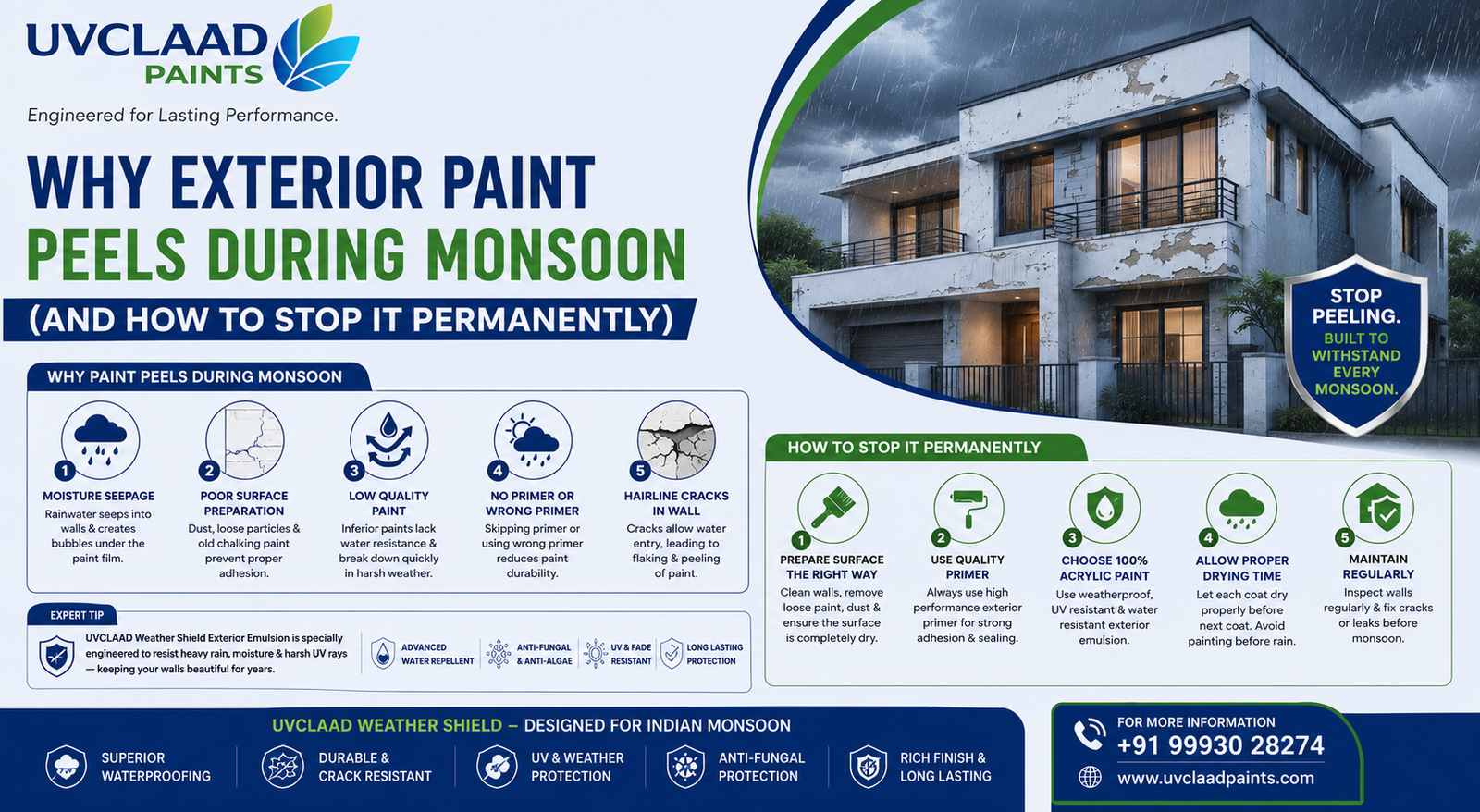
A bubble appears. You press it and it gives, like a blister. A week later the edge lifts and a sheet of paint peels away, taking a little plaster with it.
Everyone’s first instinct is that the paint was fake or low quality. In my experience that is the cause maybe one time in ten. The other nine times, the wall was trying to tell you something before it was painted.
What Peeling Paint Is Actually Telling You
Paint sticks to a wall by adhesion, a physical and chemical grip on the surface. Peeling means that grip failed.
The useful question is not “why did the paint fail” but “what broke the bond”. There are five realistic answers, and you can usually identify yours in ten minutes.
Cause 1: Moisture Pushing From Inside the Wall
The most common cause by a wide margin.
Water gets into the wall from somewhere, a crack, a failed joint, a leaking pipe, rising damp. When the sun heats the wall, that water becomes vapour and expands. It has to go somewhere, and the paint film is in the way.
The tell: peeling concentrated in patches rather than spread evenly, often near the plinth, around window frames, or below a parapet or chajja. The plaster underneath feels cool or damp.
Cause 2: Painting on an Uncured Surface
Fresh cement plaster is strongly alkaline, with a pH that can exceed 12. That alkalinity chemically attacks the binder in emulsion paint, a process called saponification.
Plaster needs 21 to 28 days of curing before painting. Not seven. Not “it looks dry”. Contractors under time pressure skip this constantly, and the failure shows up six to twelve months later.
The tell: new construction, paint lifting in broad sheets, sometimes with a soapy or slimy feel underneath.
Cause 3: Skipped or Wrong Primer
Primer does three jobs. It seals a porous surface so the finish coat is not sucked in, it blocks alkalinity, and it gives the topcoat something to grip.
Skip it and you have a finish coat sitting on raw plaster with none of that. On a compound wall you might get away with it. On a rendered facade in monsoon country, you will not.
The tell: the peeled paint comes away cleanly, with bare plaster or putty visible underneath and no primer layer.
Cause 4: Dirty or Chalky Substrate
Painting over an old chalking surface without washing it means the new paint is bonded to loose powder, not to the wall.
Same for dust, oil, algae residue or fungal growth. Any of these acts as a release layer.
The tell: peeled flakes have a powdery, dusty or greenish film on the reverse. Run a finger over the exposed wall and it comes back chalky.
Cause 5: Trapping Vapour With the Wrong Coating
Slightly counterintuitive. A very tight, low-permeability coating, some elastomerics, oil-based paints, certain waterproof coatings, applied over a wall that receives moisture from behind, seals the vapour in.
Pressure builds. The film lifts. The paint did exactly what it promised and that is precisely the problem.
The tell: large intact blisters rather than flakes, on walls with a known damp source.
How to Diagnose Yours in 10 Minutes
Do these four checks:
- Look at the back of a peeled flake. Bare plaster means no primer. Powder means a chalking substrate. Damp means moisture.
- Tape test on a dry wall. Press packing tape firmly onto a sound painted area and pull sharply. If paint comes off, adhesion has failed broadly, not locally.
- Map the pattern. Patchy near plinth, windows or parapet means moisture. Uniform across the whole wall means preparation or product.
- Feel the wall on a hot afternoon. A wall that stays cool where the peeling is has water in it.
The Repair Sequence That Works
Fix the cause first. If it is moisture, seal the crack, joint or pipe entry and let the wall dry for three to five clear days minimum. Skip this and everything below is wasted.
Then: scrape back all loose and flaking paint to a firm edge. Wire brush the area. Wash down thoroughly with clean water to remove chalk and dust, and let it dry completely.
Fill and level any resulting depressions with exterior-grade putty and sand it flush.
Apply an alkali-resistant exterior primer over the whole repaired area, feathering onto sound paint. Then two full finish coats over the entire wall, not just the patch, or you will see the repair in daylight.
Do not compress this. The drying intervals are the part that makes it hold.
What It Costs to Get This Wrong
A patch repair on one wall might cost Rs 4,000 to Rs 8,000 in labour and material. Manageable.
Redoing a full elevation because the underlying moisture was never addressed is a different number entirely, usually Rs 30,000 upward once scaffolding is back on site. And it will happen again the following monsoon if the source is still there.
Which is why the boring first step, finding and fixing the water entry, is worth more than any upgrade in paint quality. Premium paint on a damp wall fails just as reliably as cheap paint does.
Frequently Asked Questions
Why is my exterior paint peeling off?
Exterior paint peels when the bond between paint and wall fails, usually because moisture is pushing outward from inside the wall, the plaster was not fully cured, primer was skipped, or the surface was dirty or chalking when painted.
How do I stop paint from peeling in monsoon?
Fix the moisture source first by sealing cracks, joints and pipe entries, then let the wall dry for several days. Scrape back loose paint, wash off chalk and dust, apply an alkali-resistant primer, and finish with two full coats.
Can I paint over peeling paint?
No. New paint applied over loose or flaking material bonds only to that loose layer and will fail within months. All unsound paint must be scraped back to a firm edge and the surface washed and primed first.
How long should new plaster cure before painting?
New cement plaster needs 21 to 28 days of curing before painting. Fresh plaster is highly alkaline and that alkalinity chemically breaks down emulsion paint binders, causing failure months later.
Does primer prevent peeling?
Primer significantly reduces the risk by sealing porous surfaces, blocking alkalinity and improving adhesion. It cannot prevent peeling caused by an active moisture source, which must be repaired separately.