
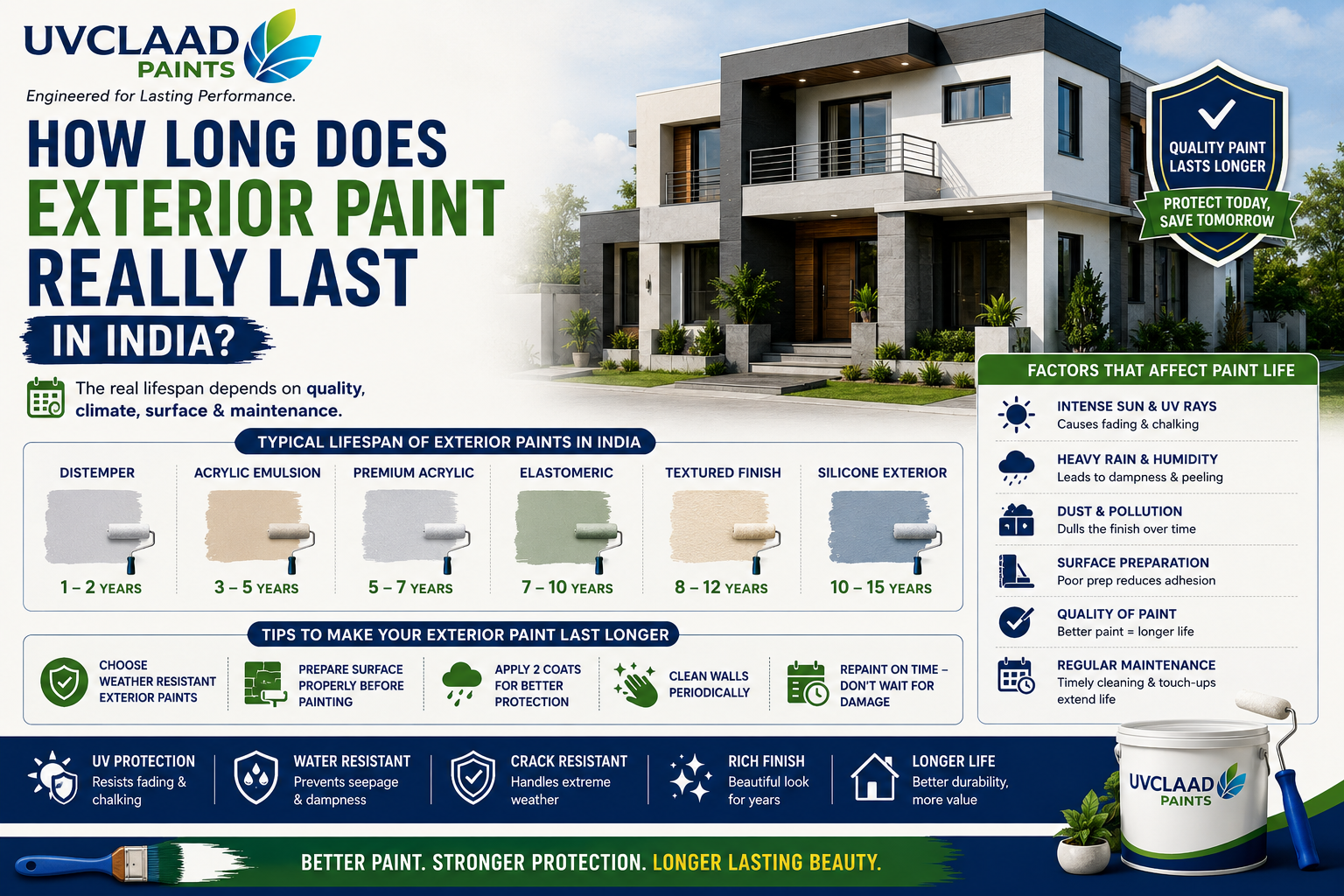
The tin says fifteen years. The dealer says ten to twelve, comfortably. Your neighbour repainted after four.
All three statements can be true at once, because they are answering different questions.
What the Warranty Actually Promises
A paint warranty is a defect guarantee, not a service life guarantee. It says the product will not fail in specific defined ways within the stated period, provided a long list of conditions was met.
Typically covered: peeling, flaking, film cracking, and colour fade beyond a defined threshold.
Typically excluded: fade within normal limits, damage from wall dampness, structural cracking, mechanical damage, failure of a substrate the paint was applied to, and anything where the manufacturer’s full system was not used.
That last exclusion carries most of the weight. Use a competitor’s primer, or no primer, and you have technically stepped outside the warranty on day one.
Realistic Life by Paint Grade
Based on typical Indian conditions with correct application:
| Grade | Stated warranty | Realistic good appearance | Realistic functional life |
|---|---|---|---|
| Economy acrylic | None to 5 years | 2-3 years | 3-5 years |
| Mid-range acrylic | 5-8 years | 4-5 years | 5-8 years |
| Premium acrylic | 8-12 years | 6-8 years | 8-12 years |
| Silicone-modified premium | 10-15 years | 7-9 years | 10-14 years |
Note the two separate columns. A wall can be functionally sound, no peeling, no cracking, while looking distinctly tired. Most people repaint at the appearance point, not the failure point.
How Climate Zone Changes the Answer
Apply these rough multipliers to the figures above:
- Hot and dry (Rajasthan, inland Gujarat, parts of MP): 0.85x. High UV, low moisture. Fading dominates.
- Composite (Delhi NCR, Indore, Nagpur, Bhopal): 0.8x. Everything at once, plus dust.
- Warm and humid coastal (Mumbai, Chennai, Kochi, Goa): 0.6x. Salt, sustained moisture, biological growth.
- High rainfall (Konkan, Northeast, Western Ghats): 0.6x. Four months of continuous wetting.
- Temperate (Bengaluru, Pune, hill stations): 0.95x. The easiest conditions in India for paint.
A premium paint rated for twelve years in ideal conditions realistically gives seven in Mumbai and eleven in Bengaluru. Same product, same application.
Coastal, Industrial and High-Rainfall Exposure
Coastal walls face airborne salt, which is hygroscopic, meaning it draws and holds moisture against the surface. Combined with high humidity, the film is rarely fully dry. Expect a third less life.
Industrial exposure adds sulphur dioxide and particulates, which are chemically aggressive to both binder and pigment. Walls near heavy industry or major highways degrade noticeably faster.
High-rainfall regions stress vapour permeability above everything else. A paint that performs beautifully in Jaipur may blister in Kochi purely because it cannot let wall moisture out.
Why Wall Orientation Matters So Much
On the same building, painted on the same day with the same product, the south wall will typically need attention three to four years before the north wall.
South takes the highest annual UV dose. West takes intense afternoon sun combined with peak heat, so it suffers thermal stress as well. North stays coolest and often looks nearly new when the south wall is chalking.
Which raises a practical option most people never consider: partial repaints. Doing the south and west elevations on a shorter cycle and the north and east on a longer one is a legitimate maintenance strategy and costs considerably less over twenty years.
The Application Factor Nobody Warns You About
This is where most of the variance actually comes from.
Two coats of premium paint applied at correct thickness on a properly prepared, primed wall might deliver ten years. The same paint over-thinned, applied in one and a half coats, on an unprimed surface that was not washed, will fail in three.
Same tin. Same warranty number. Completely different outcome.
Over-thinning is the single most common site-level problem. Specification is usually 10 to 15 percent water by volume. Adding 30 percent stretches the material and reduces dry film thickness by roughly the same proportion, and film thickness is what durability is built on.
Signs It Is Time to Repaint
- Heavy chalking on the hand test
- Visible colour difference between exposed and sheltered areas of the same wall
- Hairline crazing across the film surface
- Any flaking, however small, at edges or around openings
- Water darkening the wall during rain and taking days to clear
- Algae or fungal growth returning quickly after cleaning
Repainting at the chalking stage is far cheaper than waiting for flaking, because chalking needs washing and flaking needs scraping, filling and often putty work.
How to Extend the Life You Have
Wash the exterior once a year, ideally in October after monsoon. This removes accumulated dust, pollution residue and early biological growth, and it is the cheapest life extension available.
Seal hairline cracks as they appear rather than at repaint time. Keep vegetation clear of the wall. Fix leaking drains and overflows promptly.
Two or three of these habits can realistically add two years to a repaint cycle, which on a large home is worth tens of thousands of rupees.
Frequently Asked Questions
How often should I repaint my house exterior?
Every 5 to 8 years for mid-range paint and 8 to 12 years for premium systems in most of India. Coastal and high-rainfall locations need repainting roughly a third sooner, and south-facing walls typically need attention before north-facing ones.
Is a 15 year paint warranty real?
It is real but conditional. It covers defined failures such as flaking, cracking and severe fading, and requires the manufacturer’s full system, correct surface preparation and correct application. It is not a promise the wall will look new for fifteen years.
Why did my paint fail in 2 years?
Most two-year failures come from application rather than product, typically over-thinning, skipped primer, painting over a chalking or damp surface, or applying a single coat instead of two. An unresolved moisture source is the other common cause.
Does exterior paint last longer in dry climates?
Moderately. Dry climates avoid moisture-related failure and biological growth, but high UV still drives fading and chalking. Temperate regions such as Bengaluru and Pune give the longest realistic paint life in India.
What reduces exterior paint life the most?
Poor surface preparation, followed by over-thinning and insufficient film thickness. Coastal salt exposure and unresolved wall dampness are the leading environmental factors.