White seems like the safe choice. No colour risk, works with everything, always looks clean.
Then you paint the house and it turns out to be slightly pink in the afternoon, blinding at noon, and grey with dust by March. White is not one colour, and choosing badly among the whites is entirely possible.
Why White Is Harder Than It Looks
Pure white as a pigment concept barely exists in practice. Every white paint contains a small amount of tinter, which gives it an undertone, a slight bias toward yellow, red, blue or green.
Indoors under artificial light that undertone is subtle. Outdoors, under direct sun at 10 in the morning and again at 5 in the evening, it becomes obvious. A white with a red undertone reads distinctly pink in evening light.
This is why white sample cards are almost useless. You have to see it on the wall, in daylight, at multiple times of day.
The Four Whites and Their Undertones
| Type | Undertone | Reads as | Best in |
|---|---|---|---|
| Pure white | Neutral to slightly blue | Crisp, bright, stark | Cloudy or temperate regions, contemporary elevations |
| Warm white | Slight yellow | Soft, comfortable | Most of India, most elevation styles |
| Ivory cream | Yellow to gold | Traditional, mellow | Traditional and courtyard homes |
| Off white beige | Yellow-grey | Muted, earthy | High dust regions, larger facades |
Light Reflectance Value Explained
Light reflectance value, or LRV, measures how much visible light a colour reflects, on a scale from 0 for absolute black to 100 for pure white.
Practical figures for exterior whites: pure white sits around 88 to 92, warm white around 82 to 87, ivory cream around 76 to 82, and off white beige around 70 to 78.
Why it matters: higher LRV means a cooler wall surface, which matters on south and west elevations. It also means more glare, and more reflected light into any room whose window faces that wall.
Many Indian shade cards do not print LRV. Ask for it, or approximate by comparing swatches side by side in daylight.
Pure White: Where It Works and Where It Glares
Pure white delivers maximum brightness and maximum contrast against dark trim, doors and railings. On a contemporary elevation with black window frames it is genuinely striking.
Two problems in Indian conditions. Under strong midday sun it can be uncomfortably bright, particularly on a large unbroken facade. And it shows every mark, dust streak and water stain immediately.
Best used on smaller facades, on shaded elevations, in temperate or high-rainfall regions where walls get washed regularly, and where the architecture actively wants that crispness.
Warm White and Ivory for Softer Elevations
Warm white is the most broadly usable exterior white in India, and if you want a default recommendation, this is it.
The slight yellow undertone counteracts the blue cast of open sky, so the wall reads as genuinely white rather than cold. It handles strong sunlight without glaring. And it pairs comfortably with wood, terracotta, stone and most metal finishes.
Ivory cream takes this further and suits traditional elevations, arched openings, stone plinths and timber shutters. On a very contemporary building it can read as slightly dated.
Off White Beige for Dusty Locations
This is the pragmatic choice, and it deserves more consideration than it usually gets.
In Delhi NCR, Jaipur, Indore, Nagpur, Ahmedabad and most of the North Indian plains, walls accumulate a fine dust film continuously. A pure white wall goes visibly grey within a season. An off white beige wall accumulates the same dust and looks almost unchanged, because the dust colour is close to the wall colour.
You give up some brightness. In exchange the elevation looks maintained for four years instead of four months.
The Dirt Problem With White Exteriors
Three things drive how quickly a white wall looks dirty, and only one is the colour itself.
Dirt pickup resistance of the paint film. Smoother, harder films hold less dirt. This is a formulation property and it varies substantially between products.
Water shedding detail. Most dirt streaking on white walls comes from water running off sills, chajjas and copings without a drip mould, carrying dust down the face. Fixing the detail matters more than changing the paint.
Surface texture. Rough and textured finishes trap far more dust than smooth ones. On a textured elevation, choose a shade darker than you otherwise would.
Pairing Whites With Accent Colours
Whites are forgiving, but temperature still applies.
Pure white pairs cleanly with charcoal, black, steel blue and cool greys. Warm white pairs with coffee brown, terracotta, olive green and warm greys. Ivory pairs with deep brown, rust, mustard and natural timber. Off white beige pairs with taupe, bronze and muted greens.
The pairing that consistently disappoints is a cool pure white with a warm brown accent. It looks fine on a screen and slightly off on a building.
Frequently Asked Questions
Which white is best for exterior walls?
Warm white is the most broadly suitable exterior white in India. Its slight yellow undertone counteracts the blue cast of open sky and avoids the glare of pure white, while pairing comfortably with wood, stone and most metal finishes.
Does white exterior paint get dirty quickly?
Pure white shows dust and water streaking fastest, particularly in the North Indian plains. Off white beige accumulates the same dust but shows it far less because the dust colour is close to the wall colour.
What is the difference between pure white and off white?
Pure white has a neutral or slightly blue undertone and a light reflectance value around 88 to 92. Off white carries a yellow-grey undertone with an LRV around 70 to 78, appearing softer and hiding dust considerably better.
Is white paint good for hot climates?
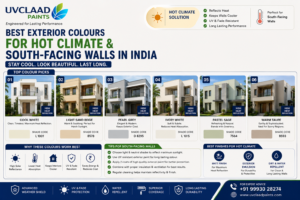
Yes. White and near-white shades reflect 70 to 90 percent of incident light, keeping wall surface temperatures substantially lower than dark colours. This makes them a sound choice for south and west-facing walls in hot regions.
Which white looks best in sunlight?
Warm white and ivory perform best under strong Indian sunlight because their yellow undertone reduces glare and prevents the cold cast that pure white can develop. Always test a 600 mm patch on the actual wall at several times of day before committing.