The contractor says forty litres. Your neighbour says he did the same size house in twenty-eight. Somebody is wrong, and it is usually not the neighbour.
Paint quantity is one of the few things in a painting job you can calculate yourself in about ten minutes. Here is how.
The Simple Formula (And Where People Get It Wrong)
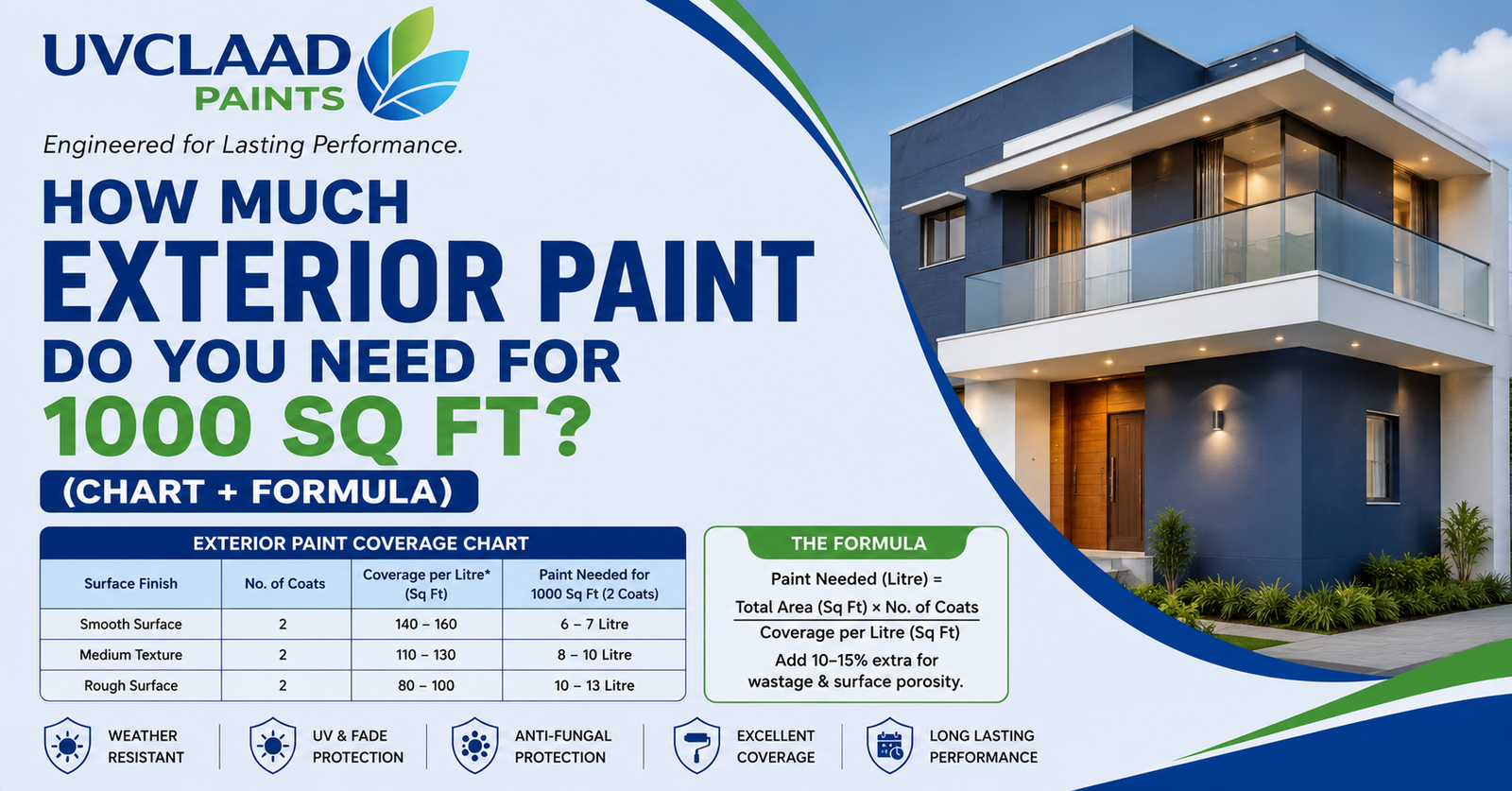
Litres needed = (Total wall area ÷ Coverage per litre) × Number of coats
Straightforward enough. Two things go wrong with it.
First, people use carpet area or built-up area instead of actual wall surface area. Those are completely different numbers. Second, they use the coverage printed on the tin, which is a laboratory figure achieved on a smooth, sealed, primed surface that your wall almost certainly is not.
Paint Coverage Per Litre Explained
Most exterior emulsions in India state 110 to 150 sq ft per litre for one coat. UVCLAAD Aura, for instance, states 130 to 150.
That range is not marketing hedging, it is real. The bottom of the range is what you get on porous or textured plaster. The top is smooth, primed, well-prepared wall.
Plan using the lower number. If you beat it, you have leftover paint for touch-ups, which you will want.
Ready Reckoner Chart by House Size
These assume exterior wall area, two finish coats, at 130 sq ft per litre:
| Exterior wall area | Paint needed (2 coats) | With 10% wastage | Suggested packs | Primer needed |
|---|---|---|---|---|
| 500 sq ft | 7.7 L | 8.5 L | 2 x 4L | 4-5 L |
| 1,000 sq ft | 15.4 L | 17 L | 1 x 20L | 8-10 L |
| 1,500 sq ft | 23 L | 25.5 L | 1 x 20L + 2 x 4L | 12-14 L |
| 2,000 sq ft | 30.8 L | 34 L | 1 x 20L + 1 x 10L + 1 x 4L | 16-18 L |
| 3,000 sq ft | 46 L | 51 L | 2 x 20L + 1 x 10L | 24-27 L |
To answer the title question directly: 1,000 sq ft of exterior wall needs roughly 15 to 17 litres for two coats.
How Surface Texture Changes Everything
Apply these multipliers to your calculated quantity:
- Smooth, primed plaster — 1.0x
- Normal cement plaster — 1.1x
- Rough or sand-faced plaster — 1.25x
- Textured or grit finish — 1.4x to 1.6x
- Exposed brick — 1.5x or more, and it varies wildly
Textured elevations are where estimates go badly wrong. That decorative sand-faced band around your first floor drinks paint.
Don’t Forget Primer and Putty
Primer typically needs 50 to 60 percent of your finish coat volume. On a wall needing 30 litres of paint, budget 16 to 18 litres of primer.
Putty is measured differently, by weight. Exterior grade putty covers roughly 18 to 22 sq ft per kg per coat. A 1,000 sq ft wall needing one levelling coat needs around 45 to 55 kg.
Most quotations omit both. That is where the “why has the bill gone up” conversation comes from.
The Wastage Factor Nobody Adds
Some paint stays in the tray. Some dries on the roller. Some goes on the tarpaulin. Some gets spilled.
Standard allowances:
- Brush and roller application — add 10 to 12 percent
- Spray application — add 25 to 35 percent
- Complex elevations with lots of edges and detail — add 15 percent
Spray looks efficient and is fast, but a significant amount of that mist never reaches the wall.
Worked Example: A Real 1200 Sq Ft Home
Double-storey, four external walls, normal cement plaster, changing from cream to warm white.
Perimeter 140 ft, height 22 ft. Gross wall area = 140 × 22 = 3,080 sq ft.
Deduct openings: eleven windows at roughly 20 sq ft each and two doors at 21 sq ft = 262 sq ft. Net area = 2,818 sq ft.
Base requirement: 2,818 ÷ 130 × 2 = 43.4 litres.
Normal plaster multiplier 1.1: 47.7 litres. Wastage at 10 percent: 52.5 litres.
Order: 2 x 20L plus 1 x 10L = 50 litres, with a 4L can in reserve. Plus roughly 26 litres of primer.
Note how far that is from the “built-up area” shortcut. A 1,200 sq ft house has nearly 2,800 sq ft of exterior wall.
Choosing the Right Pack Combination
Once you know the litres, work backwards to packs. The aim is to hit your requirement using the largest packs possible, with one small can spare for touch-ups.
For 34 litres, that is one 20L plus one 10L plus one 4L, which gives you exactly 34. For 25 litres, one 20L plus two 4L gets you to 28, with three litres in hand.
Do not round down hoping to manage. Running out mid-coat means a second trip, possibly a different batch, and a visible join line on the wall. Running two litres over costs a few hundred rupees and solves both problems.
Frequently Asked Questions
How many litres of paint for 1000 sq ft?
Roughly 15 to 17 litres for two coats at 130 sq ft per litre coverage, including a 10 percent wastage allowance. Rough or textured plaster can push this to 19 or 20 litres.
What is the coverage of exterior paint per litre?
Most Indian exterior emulsions cover 110 to 150 square feet per litre for a single coat on a smooth primed surface. Porous or textured walls reduce this significantly, so plan using the lower end of the stated range.
How much primer do I need?
Budget 50 to 60 percent of your finish coat volume. If your walls need 30 litres of paint, plan for 16 to 18 litres of exterior primer.
Does rough plaster need more paint?
Yes, considerably. Rough or sand-faced plaster increases consumption by about 25 percent, and heavily textured finishes can increase it by 40 to 60 percent compared with smooth plaster.
How do I calculate wall area for painting?
Multiply the building perimeter by the wall height to get gross area, then deduct the area of doors and windows. Use actual wall surface area, not carpet area or built-up area, which give much lower figures.