You picked a deep terracotta. Three summers later it is a dusty salmon, and only on two walls. The other two look almost fine.
That asymmetry is the clue. Fading is not really about paint quality in isolation. It is about how much ultraviolet energy hits each wall and what your pigment is made of.
How Much UV Indian Walls Actually Take
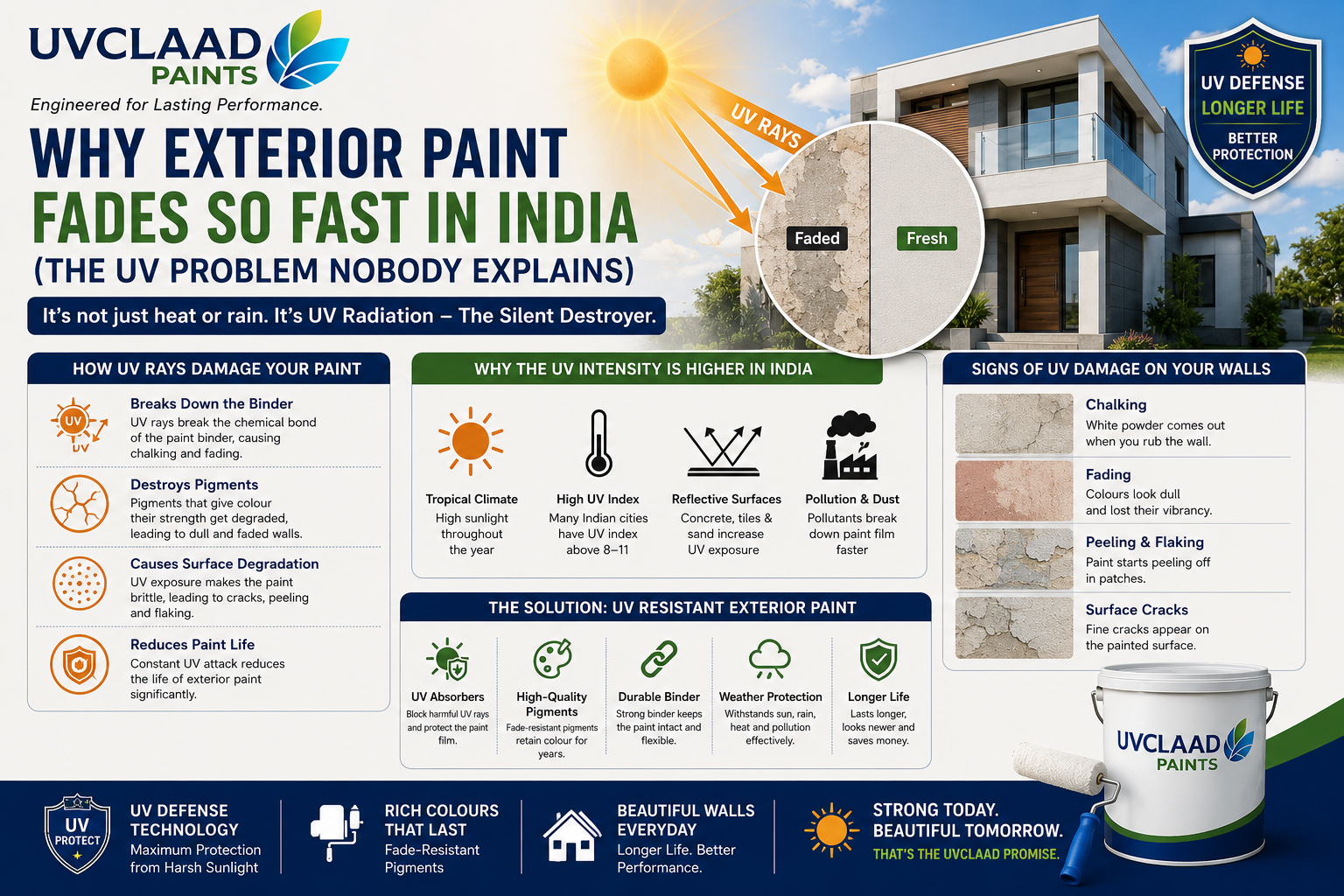
Most of India sits between 8 and 35 degrees north, which means high solar angles and long exposure. Peak UV index across the plains routinely reaches 10 to 12 in summer, and the pre-monsoon months push it higher still.
For comparison, most of Europe rarely exceeds 7. Paint formulated and warranty-rated for European conditions is being asked to do considerably more work here.
Add roughly 300 clear days a year in much of central and western India, and the cumulative dose over a decade is enormous.
What UV Does to Paint at a Chemical Level
Two separate things break down, and they matter in different ways.
The pigment is what gives the colour. UV photons carry enough energy to break the chemical bonds in certain pigment molecules. Once broken, the molecule no longer absorbs light the same way, and the colour shifts or weakens.
The binder is the resin holding everything together. UV degrades this too, breaking polymer chains at the film surface. As the binder erodes, it stops holding the pigment particles, and they wash off or rub off. That is chalking.
Here is the part most explanations skip: binder failure looks like fading. The colour is still there, it is just sitting loose on a degraded surface, scattering light differently. Wash a chalked wall and the colour often returns temporarily.
Why Some Colours Fade Faster Than Others
Roughly ranked from most to least fade-prone in Indian conditions:
- Bright reds and magentas
- Deep purples and violets
- Bright yellows and oranges
- Vivid blues and greens
- Deep browns and maroons
- Mid greys and beiges
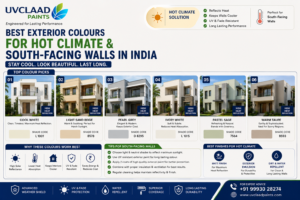
- Off whites, ivories and pure whites
Two reasons for this order. First, deeper shades contain more tinter and less white base, and tinters are usually the vulnerable component. Second, the most vivid colours are typically achieved with organic pigments.
Organic vs Inorganic Pigments
This distinction decides more than the brand does.
Inorganic pigments are mineral-based, iron oxides, titanium dioxide, chromium oxides. Their molecular structure is far more stable under UV. They deliver earthy, muted, natural colours. Yellow ochre, iron oxide red, raw sienna, and the whole family of greys and beiges.
Organic pigments are carbon-based compounds. They produce the bright, clean, high-chroma colours that inorganics simply cannot achieve. They also break down far faster under UV.
So there is a genuine trade-off. You can have a brilliant red or you can have colour retention. Not both, at any price.
The Binder Matters More Than the Pigment
If you take one thing from this, take this.
A UV-stable inorganic pigment in a weak binder will still look terrible in four years, because the binder erodes and takes the pigment with it. Binder quality sets the ceiling on everything else.
Ranked by UV durability: silicone-modified acrylic sits at the top, then pure acrylic, then styrene-acrylic, then vinyl-acrylic and PVA at the bottom. Most economy exterior paints in India are styrene-acrylic or vinyl-based.
Ask which resin system a paint uses. If the answer is a marketing phrase rather than a resin type, that itself is informative.
Which Walls Fade First on Your House
In the northern hemisphere, south-facing walls receive the highest annual solar load. West-facing walls receive less total energy but take it in the hottest part of the day, combining UV with thermal stress.
Typical order of failure: south first, then west, then east, then north. North walls often look almost new when south walls need repainting, which is why partial repaints on one elevation are common and sensible.
Unshaded parapets and boundary walls fade fastest of all, because they take sun on both faces plus the top.
What to Look For Before You Buy
- Resin type stated on the technical data sheet, not just the label
- Inorganic pigment shades if colour retention is the priority
- A stated colour warranty, separate from the film warranty
- Titanium dioxide content, since rutile grade TiO2 also provides UV screening
- A sample panel you can leave on a south wall for one summer before committing on a large project
That last one is unglamorous and more useful than every brochure combined.
How to Slow Fading Without Changing Your Colour
If you are committed to a shade that is not ideally UV-stable, a few things still help.
Achieve full film thickness across two proper coats. A thicker film has more pigment in reserve below the degrading surface layer, so visible fade takes longer to develop.
Wash the elevation annually. Dust and pollution film scatter light and make a wall look faded before the pigment has actually degraded much. A clean wall often looks several years younger than it is.
Use the vulnerable shade on north and east elevations and a more stable one elsewhere. Nobody looks at all four walls simultaneously, and a two-shade scheme aligned to orientation is a legitimate design decision rather than a compromise.
And where the budget allows, put the better product on south and west. Splitting the specification by orientation is standard practice on commercial projects and rarely considered on homes.
Frequently Asked Questions
Which paint colour fades the fastest?
Bright reds, magentas and deep purples fade fastest because they rely on organic pigments, which break down quickly under ultraviolet light. Off whites, ivories, greys and earthy beiges retain colour best because they use stable inorganic pigments.
How do I stop my wall paint from fading?
Choose a paint with a silicone-modified or pure acrylic binder, select inorganic pigment shades where possible, and use lighter colours on south and west walls. Correct film thickness across two full coats also matters significantly.
What is UV resistant paint?
UV resistant paint uses stable binders and pigments that resist breakdown under ultraviolet radiation, often combined with titanium dioxide which screens UV. It slows both colour loss and the binder erosion that causes chalking.
Why do south facing walls fade first?
South-facing walls receive the highest annual solar radiation in the northern hemisphere. West-facing walls follow, because they take intense sun during the hottest part of the day, adding thermal stress to UV exposure.
Do darker colours fade more?
Yes, generally. Deeper shades contain more tinter and less white base, and the tinters carrying that depth are usually the least UV-stable component in the formulation.