
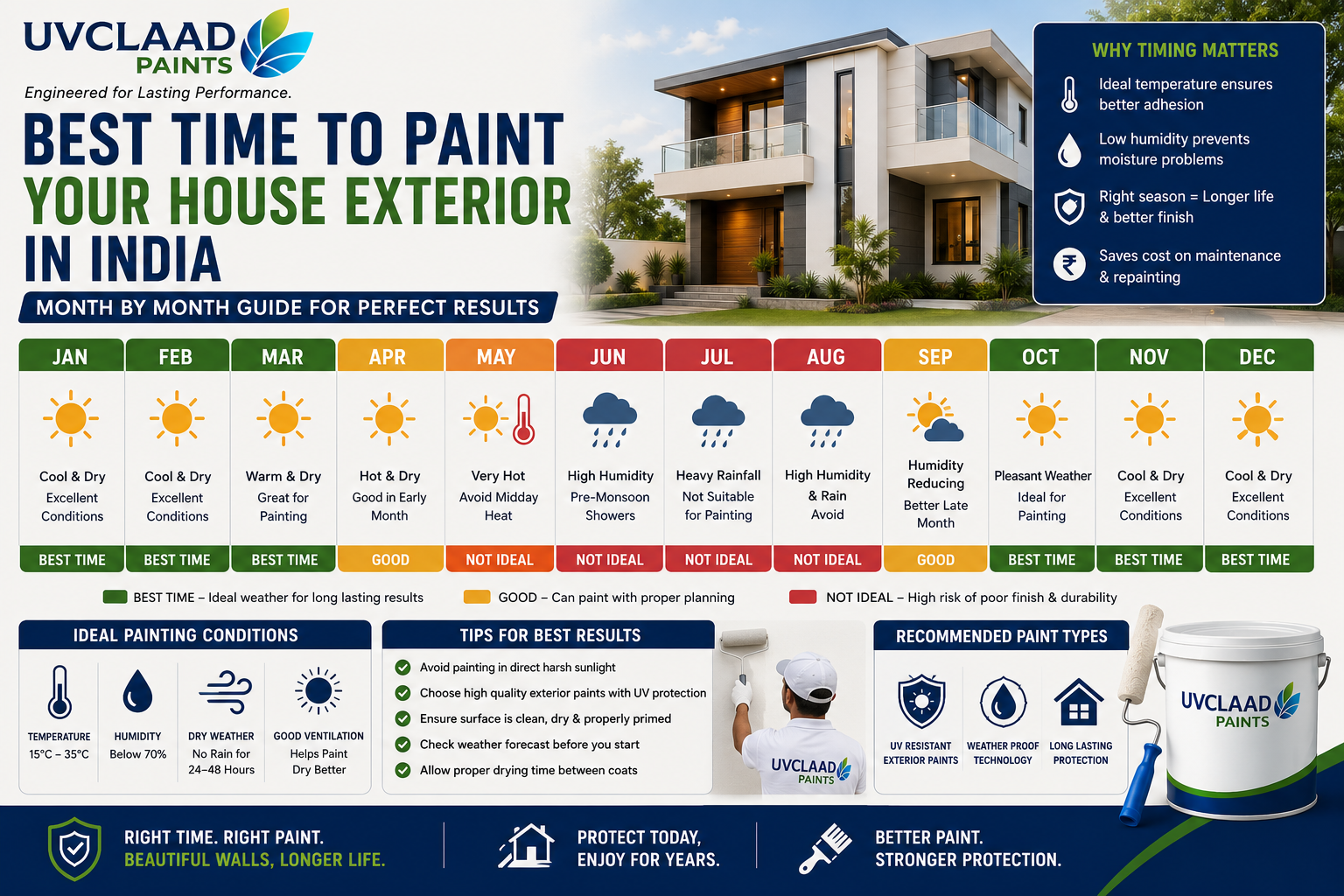
There is a reason painting contractors in India are impossible to book in November and available immediately in July.
Timing is not a minor detail on an exterior job. It determines whether the film cures properly, and a well-applied coat at the wrong moment fails as reliably as a badly applied one.
The Three Conditions Paint Needs
Surface temperature below 40 degrees Celsius. Note that this is wall temperature, not air temperature. A south-facing wall in May Delhi can reach 55 degrees while the air reads 42. Paint applied to a hot wall dries before it levels, giving poor flow, visible lap marks and reduced adhesion.
Relative humidity below about 85 percent. Water-based emulsions cure by water evaporating out of the film. At very high humidity that evaporation slows dramatically, extending drying time and leaving the film vulnerable for longer.
No rain for 24 hours after application. Most exterior emulsions become rain-resistant in four to six hours and take about seven days to fully cure. Rain within the first day washes off or damages an uncured film.
Month by Month Painting Calendar for India
| Month | Suitability | Notes |
|---|---|---|
| January | Very good | Cool and dry. Watch for morning dew and fog in the north. |
| February | Excellent | Probably the best month across most of India. |
| March | Excellent | Ideal in the north, getting warm in the south by month end. |
| April | Fair | Work shaded elevations only. Avoid midday. |
| May | Poor | Surface temperatures too high on exposed walls. |
| June | Avoid | Monsoon onset. Unpredictable rain. |
| July | Avoid | Peak monsoon in most regions. |
| August | Avoid | Continued high humidity and rainfall. |
| September | Poor to fair | Monsoon withdrawal. Walls still saturated. |
| October | Very good | Season opens. Allow walls to dry out first. |
| November | Excellent | Peak season. Book contractors early. |
| December | Very good | Excellent, though short daylight hours reduce output. |
Why October to March Works Best
In that window you get moderate temperatures, low humidity across most of the country, minimal rainfall, and long stable dry spells.
There is also a practical reason. Monsoon has just finished revealing every weakness in the building. Cracks that leak, joints that fail, walls that hold damp. October is when you can actually see what needs fixing before you paint over it.
Painting in March, six months before monsoon, means you are treating problems you cannot currently observe.
Painting in Peak Summer: The Hidden Risk
May painting is common because contractors are cheap and available. The risks are real but manageable if you are disciplined.
Work the shade. Start on the west wall in the morning and the east wall in the afternoon, following the shadow around the building. Never paint a wall in direct sun.
Stop work between roughly 11 am and 4 pm on exposed elevations. Check surface temperature by hand before starting: if you cannot hold your palm flat against the wall comfortably, it is too hot.
Expect faster drying, which reduces open time and makes maintaining a wet edge harder. Work smaller sections than usual.
Monsoon Painting: When It Is Unavoidable
Sometimes there is no choice, a handover date, a sale, an event.
If so: work only in confirmed dry spells of at least three consecutive days. Verify the wall is genuinely dry, not just surface-dry. Use the plastic sheet test. Reduce thinning slightly to compensate for slower evaporation. Extend recoat intervals well beyond the stated figure, often to 8 to 12 hours.
And accept a shorter service life. A monsoon-applied coat, however carefully done, will generally not match one applied in November.
Regional Differences
North India (Delhi, Punjab, UP, Rajasthan): October to March, avoiding dense fog periods in late December and January when morning dew keeps surfaces damp until midday.
Western India (Mumbai, Gujarat, MP): October to March. Coastal humidity in Mumbai narrows the window slightly at both ends.
South India (Tamil Nadu, Kerala, coastal Karnataka): more complicated, because of the northeast monsoon in October and November. January to April usually works better here, and Chennai in particular should avoid October and November entirely.
Northeast and Konkan: the dry window is genuinely short. November to February, and plan around it.
Reading Humidity and Surface Temperature
You do not need instruments, though a Rs 400 infrared thermometer is a worthwhile purchase for a large job.
For humidity, any weather app gives you a usable figure. Above 85 percent, postpone.
For surface temperature, use your palm. Comfortable to hold flat means you are fine. Uncomfortable within three seconds means wait for shade.
For dew point, the practical version is simple: if the wall was wet with dew this morning, do not start until it has been dry for at least two hours.
Planning Your Repaint Timeline
Working backwards from a November start:
September, inspect the building at the end of monsoon and identify repairs. Early October, complete crack sealing, waterproofing and plaster repairs, then let everything dry. Late October, wash down the elevations. Early November, putty and prime. Mid November, finish coats.
That sequence gives every wet stage its drying time and finishes before Diwali. It also means booking your contractor in August, because by October the good ones are committed.
Frequently Asked Questions
Can I paint my house during monsoon?
It is best avoided. If unavoidable, work only during confirmed dry spells of three or more days, verify the wall is dry through using a plastic sheet test, extend recoat intervals to 8 to 12 hours, and expect a shorter service life.
What is the best month to paint a house in India?
February and November are the strongest months across most of India, offering moderate temperatures, low humidity and stable dry weather. October to March is the broader safe window, though Chennai and coastal Tamil Nadu should avoid October and November.
Is it bad to paint in summer?
Peak summer is risky because surface temperatures on exposed walls can exceed 50 degrees Celsius, causing paint to dry before it levels. If you must, follow the shade around the building and stop work between 11 am and 4 pm.
What humidity is too high for painting?
Above about 85 percent relative humidity, water evaporation from the film slows sharply, extending drying time and leaving the coating vulnerable. Postpone until conditions improve rather than compensating with heavier thinning.
How soon after rain can I paint?
Allow three to five clear dry days after heavy rain before painting a plastered wall. Verify dryness with a plastic sheet taped to the wall for 24 hours rather than judging by surface appearance alone.